Updated on June 6, 2026, for accuracy and clarity.
Furniture retailers, tired of seeing the same office chair designs everywhere? Enter Stellar, your solution to break the monotony. In China, many manufacturers offer office chairs, but the catch is, that they often share identical designs due to the lack of their own molds. This results in customers receiving similar chairs from various sources.
That means as a retailer you do not have any product differentiation and therefore you are forced to enter a price for for customers who can buy the same chair from another supplier who is selling for less.

Not so with Stellar – a leading office chair manufacturer based in Foshan, China that has revolutionized the game by investing in its own molds. This strategic move ensures that the chairs you get are not just ordinary; they’re distinct and stand out from the crowd. With Stellar, you’re not just investing in a chair; you’re choosing something extraordinary and refreshingly different from the standard options available in the market.
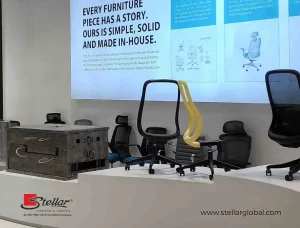
Office chair molds extend beyond traditional designs, facilitating the production of various ergonomic chairs, task chairs, executive chairs, and gaming chairs. Manufacturers can customize moulds to accommodate specific design variations and functionalities, allowing for a diverse range of chairs tailored to meet the unique needs of users in different office settings. Ultimately, these molds are a cornerstone in the production of sturdy, comfortable, and aesthetically pleasing office chairs, ensuring a consistent standard of quality.
Used for crafting plastic parts like chair backs, bases, armrests, and smaller elements.
Involves injecting heated plastic into the mold cavity, allowing it to cool and harden to the desired shape.
Employed for office chairs with metal parts, utilizing casting or stamping techniques.
Casting involves pouring molten metal into a mold, while stamping uses high pressure to shape a flat metal piece.
Essential for creating the padding of office chair seats and backs.
Involves mixing liquid foam components, and pouring them into a mold where they react and expand, solidifying to fill the mold.
Used for crafting specific chair parts such as wheels or certain bases.
Involves heating and pouring materials like metal or plastic into the casting mold, allowing them to solidify into the desired shape.
1. Mold Design and Fabrication:
2. Material Preparation:
Different materials are prepared depending on the chair component. For plastic parts, pellets undergo a drying and heating process to enhance flowability. In contrast, metal parts may involve the use of molten metal for die casting.
3. Molding Process:
This is where the magic happens! Injection molding is employed for plastic parts, injecting molten plastic under high pressure into the mold cavity, where it cools and solidifies. For metal parts, die casting comes into play, forcing molten metal into the mold cavity under high pressure. Other techniques like blow molding or rotational molding might be used based on the material and part complexity.
4. Cooling and Demolding:
Once the material cools and solidifies, the mold opens, releasing the formed chair component. The cooling time varies depending on the material and part size.
5. Finishing and Assembly:
The formed components undergo additional processing, such as trimming, smoothing, or surface finishing. Hardware elements like screws, bolts, and casters are then installed. Finally, different components are assembled to form the complete office chair.
6. Quality Control:
Ergonomics:
Ensure the mold supports good posture by replicating features like backrest angle, lumbar support, armrest placement, and adjustability mechanisms.
Ease back pain and fatigue by allowing adjustments to seat height and backrest angle.
Material Compatibility:
Choose mold materials that match the intended chair component (plastic, metal, etc.).
Consider factors like mold temperature resistance, pressure tolerance, and compatibility with release agents.
Design the mold cavity with precision to replicate the chair component’s dimensions accurately for consistent fit and functionality.
Determine the optimal wall thickness for the chair component, considering its intended use and load-bearing capacity.
Integrate efficient ejection mechanisms for easy removal of the formed component without damage.
Optimize draft angles for smooth part release and prevention of sticking.
Consider the desired surface finish of the chair component and design the mold cavity accordingly, incorporating textured surfaces if needed.
Design the mold for easy operation and maintenance during production, including factors like cooling channels, parting lines, and accessibility for cleaning and repairs.
Balance the initial investment in mold design with projected production volume and desired product quality.
Choose cost-effective materials and techniques while maintaining quality standards.
Design the mold with flexibility to accommodate potential modifications or variations in the chair design.
Ensure the mold design adheres to safety regulations and minimizes environmental impact.
Consider eco-friendly materials and design for efficient material usage and recycling potential.
Conclusion: In conclusion, at Stellar, we take pride in our commitment to crafting high-quality office chairs through our meticulous mold design and manufacturing process. Our expertise in injection molding, ergonomic considerations, and material selection ensures that each chair meets the highest standards of comfort and aesthetics for the modern workspace.
With a factory spanning 20,000 square meters in Foshan, China, Stellar stands as a leading office chair manufacturer with a remarkable 3 decades of experience. Our dedication to excellence is reflected in the precision of our molds, resulting in chairs that not only enhance productivity but also prioritize user well-being.
Experience the Stellar difference in office seating. Explore our diverse range of office chairs crafted with precision and care. Elevate your workspace with furniture that combines functionality, comfort, and unparalleled design. Contact us today to discover why we are the trusted choice for office chairs, exporting to over 100+ countries worldwide. Let Stellar furnish your office with the perfect blend of quality and style. As a retailer, benefit from a partnership that is designed to last for life.
Office chair molds are used to manufacture chair components with consistent quality, shape, and dimensions. They help produce parts such as backrests, seat shells, armrests, chair bases, and foam cushions with precision. By using specialized molds, manufacturers can maintain product consistency across large production volumes while reducing errors and material waste.
Molds are important because they ensure consistent quality, efficient production, and accurate component dimensions. A well-designed mold allows manufacturers to produce identical chair parts repeatedly, which improves assembly accuracy, product durability, and overall manufacturing efficiency. Reliable molds also help maintain quality standards across multiple production batches.
The most common office chair molds include injection molds, foam molds, casting molds, and metal-forming molds. Injection molds create plastic components such as armrests and chair frames, while foam molds shape seat and back cushions. Different mold types work together to produce ergonomic, durable, and visually appealing office chairs.
Proprietary office chair molds provide exclusive product designs that help brands stand out in competitive markets. They enable manufacturers to create unique chair styles, maintain consistent product quality, and simplify repeat orders. For buyers and importers, proprietary molds can support stronger brand identity and reduce the risk of identical products appearing across multiple suppliers.
A high-quality office chair mold produces precise, consistent, and defect-free components throughout its lifespan. Key indicators include accurate dimensions, smooth surface finishes, durable mold materials, and the ability to maintain performance during repeated production cycles. High-quality molds contribute to better product quality, fewer manufacturing defects, and longer-term production reliability.

Stellar Global is a leading international office furniture manufacturer and supplier with over 34 years of industry experience, crafting ergonomic chairs, desks, workstations, and commercial furniture shipped to customers around the world.